Christmas is coming Part 3 - The Gifts You Should Not Accept
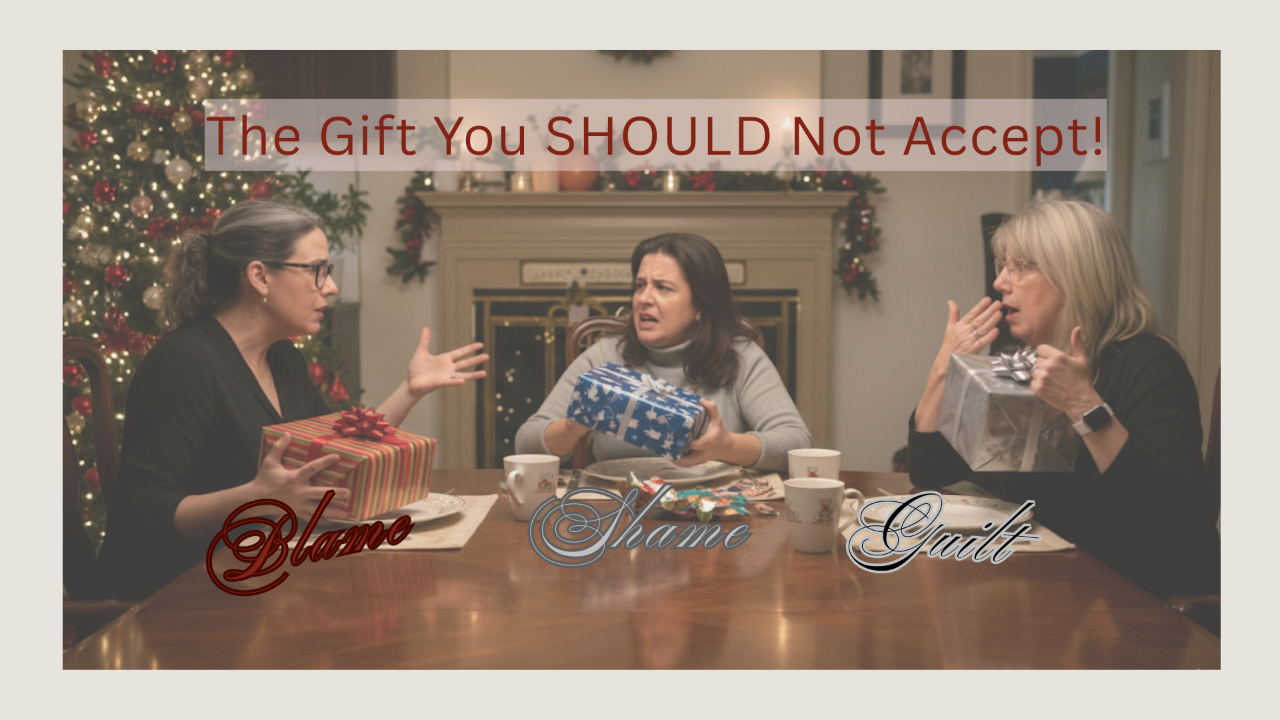
Training: Christmas is Coming—The Gifts You Should Not Accept
Today we are talking about the reality that Christmas is coming, and you don’t need to accept every gift that is given to you. Our goal is to recognize, reject, and redirect holiday negativity so we can protect our peace and our relationships.
I. Recognize the Warning Signals
The first thing to recognize is the stress surrounding us this time of year. There is a lot of pressure to get everything perfect at the last minute. When you hear snarky comments or passive-aggressive jabs, those moments can steal your peace and your connection. Today, we are going to learn to protect both.
You will learn to recognize your body’s warning signals, get practical about rejecting those "gifts" with boundaries, and practice responding with peace so you can leave the holidays proud of how you showed up.
Think back to the last time you felt a sudden spike of tension or heat in your body from a difficult comment. That visceral reaction—sometimes called the "heat of the moment"—is proof that an unwanted gift of negativity has arrived. For me, I feel my heart pounding. For others, your face might get flushed, you might feel defensive, or you might feel your emotional walls go up. These signals are your body trying to tell you: "Watch out. Warning."
II. The ABCs of Peace
When those signals hit, I want you to use a tool I teach all my clients: The ABCs of Peace.
-
Anchor: Ground yourself. Whether you are sitting or standing, feel your feet on the floor. Place one hand on your chest and one on your belly. Notice those three points of contact: the feet, the belly, and the hand on the heart.
-
Breathe: Breathe through your belly, watching it rise. Exhale through your mouth, slow and soft. I’ll count: in for three, out for four. Relax your jaw and your shoulders. The goal is to move oxygen from the back of the brain to the front, where we can think and process.
-
Clarify: Evaluate how you feel and clarify what you want to feel. This practice helps us calm down so we can move to the next step.
III. Assertive Communication (Rejecting the Gift)
Once we are calm, we can use assertive communication. This allows us to set a boundary and reject the negativity being offered without being aggressive. You are awesome, and you have to give yourself permission to say "no." Setting boundaries is about recognizing your value and your right to peaceful surroundings.
We use "I statements" to stay in control of what we want. For example:
-
"I am not discussing that today. I’m here to enjoy time with the family."
-
"I appreciate your concern, but I’m going to choose a different focus right now. Let's watch the kids open their presents."
Whether people respond well or not, we can control our own choices and how we show up. But that has to be intentional.
IV. The Soft Answer (Redirecting with Peace)
The third step is responding with peace. Instead of accepting their negativity, what gift are you going to give them?
Proverbs 15:1 says, "A soft answer turns away wrath." If someone comes at you with anger, reduce your voice. Slow down your tone and your tempo. This helps de-escalate the situation.
I remember a time when a family member got right in my face, venting his frustrations. I could feel the tension rising, but I chose to just stand there and listen. I let him speak for about 30 seconds without interrupting. When he was done, I said, "I hear you. I hear how frustrated you are, and I see how difficult this situation is for you."
That validation helps people feel seen and heard so they don't feel the need to keep attacking. By choosing empathy over matching their negativity, you allow them to receive your gift of peace. You can pivot by saying: "I see this matters to you, and I’m not going to get into it right now. Let’s set the table together instead, and we can talk about this tomorrow after we’ve enjoyed the day."
V. Your 72-Hour Challenge
-
Today (24 Hours): Catch the warning signal in your body. Anchor yourself and do the ABCs of Peace within 10 seconds.
-
Tomorrow (48 Hours): Use a boundary line. Check in with yourself and speak your "I statement."
-
The Next Day (72 Hours): Practice a soft answer. Validate someone who is struggling and respond with love.
You don’t have to "white-knuckle" through the holidays. You can choose your peace. If you want more coaching, join my upcoming group in January focused on enhancing communication and improving relationships. You are awesome, and I want to help you make this your best year ever.
Drop me an email with your thoughts on this post!
We hate SPAM. Let me know how I can support you!
Meet the Author